
Buttermilk Substitute
Make a buttermilk substitute that actually works: the exact ratio, the 10-minute rest, and which swap to use for baking versus marinating.
The Job Is Acid, Not Thickness
Most people either pour in plain milk and hope, or splash in vinegar and start mixing 30 seconds later. Both give you flat biscuits and that soapy, metallic taste that comes from baking soda with nothing to react with.
Buttermilk is in your recipe to bring acid, and acid is what you have to replace. Measure 1 tablespoon lemon juice or white vinegar per cup of milk, let it sit, and you are back in business.
The Ratio To Memorize
Put 1 tablespoon of lemon juice or white vinegar in a measuring cup, fill to the 1 cup line with milk, stir, and wait.
Give It Ten Minutes
The acid needs 5 to 10 minutes to sour the milk, and it will only look slightly curdled — it never thickens like real buttermilk.
Yogurt When You Need Body
For marinades, thick batters, and dressings, whisk 3/4 cup plain yogurt with 1/4 cup milk so the mixture actually clings.
Whole Milk Beats Skim
Buttermilk carries a little fat along with the tang, so whole milk makes the closest swap and skim leaves baked goods pale and dry.
The method
- 1
Measure the acid first
Add 1 tablespoon of lemon juice or plain white vinegar to a liquid measuring cup. Apple cider vinegar works too but leaves a faint fruity note.
- 2
Fill to the line with milk
Pour whole milk in until you hit the 1 cup mark. Unsweetened soy milk works the same way if you are skipping dairy.
- 3
Stir and walk away
Give it one quick stir and let it sit 5 to 10 minutes on the counter. You are looking for a few small curdled flecks and a sour smell, not pudding.
- 4
Scale it to what you need
Keep the same 1 tablespoon of acid per cup of milk. For half a cup, use about 1 1/2 teaspoons of acid.
- 5
Switch to yogurt if it needs to cling
When the buttermilk is soaking chicken or thinning a dressing, thin plain yogurt or sour cream with milk instead. Soured milk is too thin for that job.
- 6
Use it right away
Pour it into the batter as soon as the recipe calls for it. Sitting longer will not improve it, and a batter with baking soda starts losing lift the minute it is mixed.
Show what you know
Three questions. See if you can call these the way a baker would.
Question 1 of 3
You are out of buttermilk for cornbread that calls for baking soda, so you use plain milk straight. What happens?
Put it to work
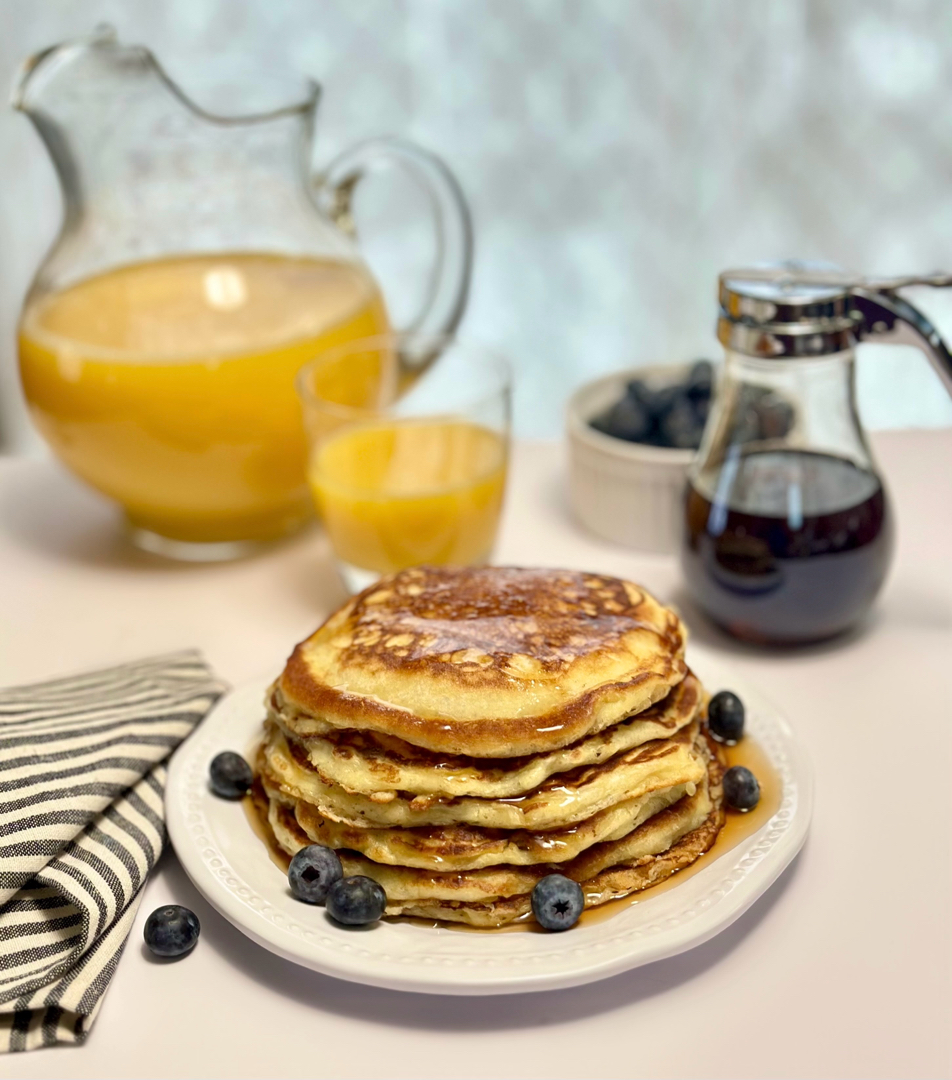
A soured-milk stand-in works perfectly here — the acid hits the baking soda and you get tall, fluffy pancakes without a trip to the store.
★ breakfast
 breakfast
Classic Buttermilk Pancakes
These classic from scratch pancakes are light and fluffy and are ready to soak up pools of melted butter and of course, lots of maple syrup! The batter is super simple to make too!
 Bryan Asher
Ingredients
- 2 1/4 cups Buttermilk
- 2 Large eggs; room temperature
- 1 tsp Vanilla extract
- 4 Tbsp Unsalted butter; melted
- 2 cups All-Purpose Flour
- 1 tsp Baking soda
- 2 tsp Baking powder
- 1/2 tsp Salt
- 3 Tbsp Granulated sugar
Instructions
- 1In a medium-sized bowl, whisk together the buttermilk, eggs, and vanilla until well combined. Set aside.
- 2Next, in a separate large bowl, sift the flour flour once before measuring. Then sift together the flour, baking soda, baking powder, salt, and sugar. Set aside.
- 3Slowly whisk the melted butter into the buttermilk mixture until well combined.
- 4Pour the wet ingredients into the dry ingredients. Use a wooden spoon or rubber spatula to stir the mixture until just combined and smooth. *Do not overmix the batter or the pancakes will be flat.
- 5To the greased and hot griddle (preheat about 5 minutes before cooking), pour about 1/2-2/3 cup of batter for each pancake. Cook 2-3 minutes on one side or until the edges appear cooked and bubbles in the batter burst, flip and cook 2-3 minutes on the other side or until golden brown. Repeat the process until all of the batter is used.
- 6Serve warm with butter, maple syrup or honey.
P.S. Pepper keeps the recipe, the timings and your own notes in one place — so the next time you cook it, you're not starting from a search box.

More cooking tips
Never lose a recipe again
Save everything. Stay organized. Share with friends.